Moons, Castles, Trees | AI Chronotopes was a free, international open call and online exhibition at The Wrong Biennale 2025–2026, the seventh edition of the world’s largest digital art biennale.
Curated by Danish artist Kasper Bergholt, the pavilion asked for AI art and art about AI in any still-image form.
More than 800 works were submitted; eight artists were selected. The call closed on 15 September 2025 and the exhibition ran from 1 November 2025 to 31 March 2026.
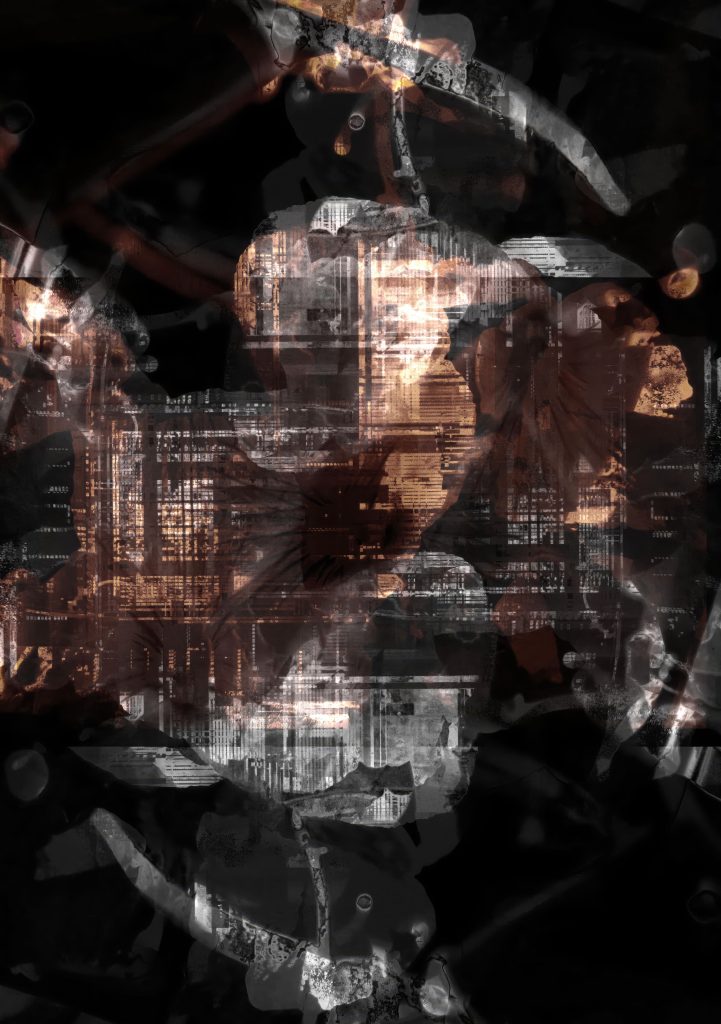
The idea: chronotopes in the age of the image machine
Bakhtin coined chronotope for the knot where time and space are tied together in a work of art: the moment a landscape starts to carry history, and a date starts to have a shape.
Moons, castles and trees are some of the oldest such knots we have: a moon dates a night, a castle holds a century, a tree keeps time in rings.
The open call asked what happens to these when images are no longer taken or made but generated – when every moon is every moon at once.
The brief was deliberately open. Photography, drawing, painting, collage, code, glitch, visual poetry, ekphrasis, scanned prints and hybrid analogue–digital work were all welcome.
Artists did not have to use AI; they only had to take a position on it.
A pack of ten high-resolution digital “negatives” – images that had bent, bled or broken – was offered as raw material, together with a curatorial essay titled The Art of Artificiality.
“Time, as it were, thickens, takes on flesh, becomes artistically visible; likewise, space becomes charged and responsive to the movements of time, plot, and history. This intersection of axes and fusion of indicators characterizes the artistic chronotope.”
Mikhail Bakhtin
“Nothing passes without leaving a trace. All foregone will be accounted for. What comes to light is only what was hidden inside.”
A. A. Ukhtomsky
In pale moonlight /
Yosa Buson
the wisteria’s scent /
comes from far away
Selected artists
Eight artists were chosen from more than 800 submissions received from around the world:
- Alexander Limarev
- Baokang Zhao
- Chaeyeon Kang
- Jack Tuttle Snell-Ryan
- Javier Aparicio Frago
- Joseph Farbrook
- Michele Rinaldi
- Natasha Burenina
Visit the exhibition: Moons, Castles, Trees: AI Chronotopes
The open call at a glance
- Title: Moons, Castles, Trees | AI Chronotopes
- Context: official pavilion, The Wrong Biennale 2025–2026 (7th edition)
- Curator: Kasper Bergholt, Copenhagen
- Submission deadline: 15 September 2025 (closed)
- Exhibition: 1 November 2025 – 31 March 2026, online; still accessible
- Format: 1–6 still images (JPG/PNG), short bio and captions
- Fee: none. Rights: artists kept all rights
- Response: 800+ submissions, 8 artists selected
Questions
What is The Wrong Biennale?
The Wrong is a decentralised, mostly online biennale of digital and new-media art, running since 2013. Each edition is made up of independently curated “pavilions” hosted around the world, physical and virtual. Moons, Castles, Trees | AI Chronotopes was one of the pavilions of the 2025–2026 edition.
What is an “AI chronotope”?
A chronotope, in Mikhail Bakhtin’s sense, is the way a work of art binds a particular time to a particular place. An AI chronotope is what that binding becomes when the image is generated rather than recorded: a moon that belongs to no night, a castle assembled from a thousand castles. The call invited artists to work in, against or around that condition.
Did the works have to be made with AI?
No. The call welcomed both AI art and art about AI. Analogue, scanned, hand-made and hybrid works were accepted alongside generated and glitched images; the only requirement was a still image and a point of view.
Is the open call still open?
No. Submissions closed on 15 September 2025. The exhibition itself stays online at ai.chronotopes.net. News of future calls is posted on chronotopes.net.
Who curated it?
Kasper Bergholt (b. 1978, Copenhagen) is a Danish artist working with code, text and the photographic image.
His digital practice goes back to the early 1990s, when he ran NetLock, a Danish bulletin board system on the Maximus platform.
Today it spans system poetry, blockchain inscription, generative work and software for obsolete machines. A system poem he wrote in 2011 was inscribed into the Bitcoin blockchain with Ordinals in 2024; Sun: Triptychs for Solar Eclipses (2026) is a generative work keyed to the 72 eclipses of Saros 126; and snd-drft (EIN. MEER. VON. SAND., 2026), written in APL and Pascal, is an MS-DOS demo that turns the inscriptions of Denmark’s 1738 Sand Drift Monument into sound.
He has shown work at the Oculus in New York, at The Ooodi in Helsinki with the Finnish National Gallery and at Blackrock Castle Observatory in Cork, as well as in Melbourne, London, Atlanta, Minneapolis, Budapest, Warsaw, Glasgow, Taipei and Chongqing. His poetry in Danish has appeared in Hvedekorn and Slagtryk. He holds an MA from the University of Copenhagen and is a member of the Royal Photographic Society and Rhizome.
Moons, Castles, Trees was his first curatorial project sine NetLock BBS.