EIN. MEER. VON. SAND. (September, 2026) is a program for MS-DOS about a sandstone monument raised in 1738 at Tibirke, near Tisvilde in North Zealand, Denmark, to mark the end of two centuries of sand drift that had buried fields, streams and whole villages along the coast.
The executable program, SAND.EXE, is written in Turbo Pascal, compiled with Free Pascal for DOS, and targets a 386 with a VGA graphics chip and a Sound Blaster 16 sound card.
It ships with its soundtrack, a batch file, a DOSBox configuration and nothing else it needs.
The score and the raw audio (8-bit, 22050 Hz, stereo) were generated separately in APL. The audio sits beside the executable in its own file, SAND.SND, and is streamed from disk while the program runs.
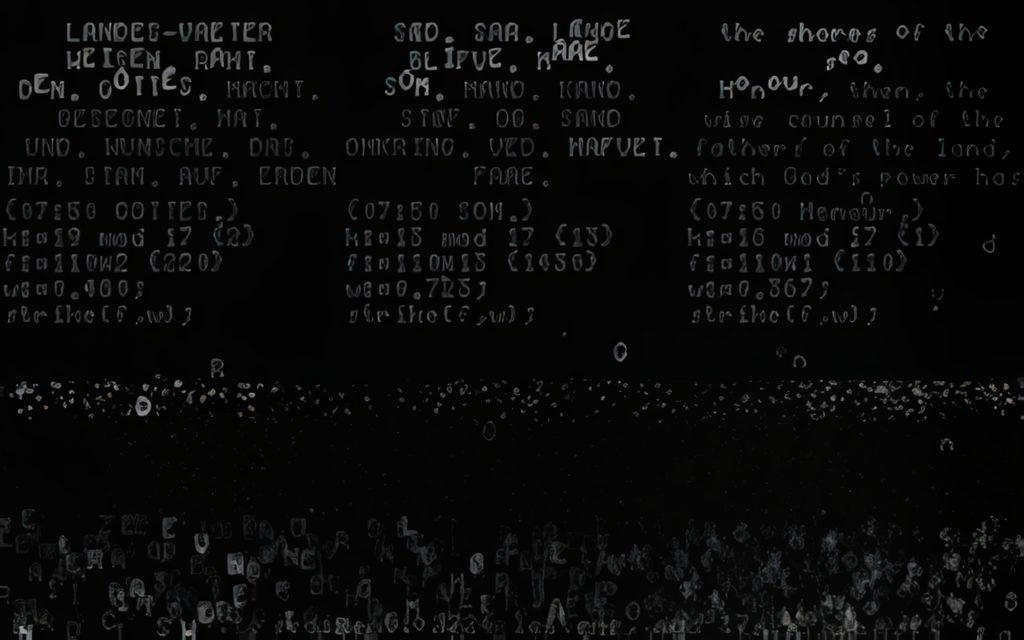
In that sense, the work stacks three layers of obsolescence on top of each other: an 18th-century inscription (in three languages, German, Danish, and Latin), a 1990s hardware target, and a programming language most people last used in the mid-90s.
Letters into partials
The monument has three inscribed faces: Danish, German and Latin. The Latin face is now largely lost under moss, so the demo reads the two surviving faces and adds an English translation as a third column.
The engine parses all three texts one letter at a time. Each letter is mapped to a partial of A2 (110 Hz); which partial depends on the letter’s position in the alphabet, taken modulo some value.
Over the piece’s 8 minutes 54 seconds, that modulus drifts from 12 to 17. The same letter, then, does not keep the same pitch. The link between what you see on screen and what you hear is loosened as the piece goes on.
The letters run horizontally as the story of Amtmand Frederik von Gram, Røhl and the taming of the sand, and vertically each one is swapped for a frequency.
Words the three texts share, “sand”, “wind”, “sea”, “1738”, “Gram”, “Røhl”, “Frederik”, “Christian”, light up in all three columns at once showing how close Danish, German and English still are underneath.
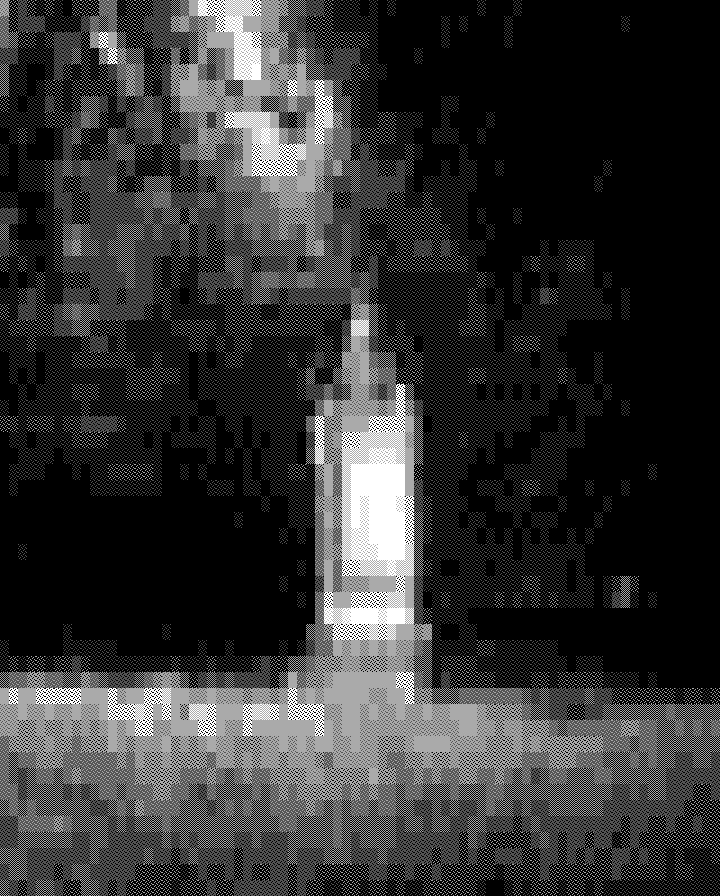
SAND.ANS
The look of the demo belongs to the bulletin-board era of the early and mid-1990s, when the screen was a fixed grid of characters and anything that looked like a picture had to be built out of the extended ASCII set and ANSI colour codes.
That world was swept away fast, between late 1994 and 1996, when cheap dial-up internet and graphical browsers arrived and thousands of bulletin boards went dark within a year or so.
Where it was released
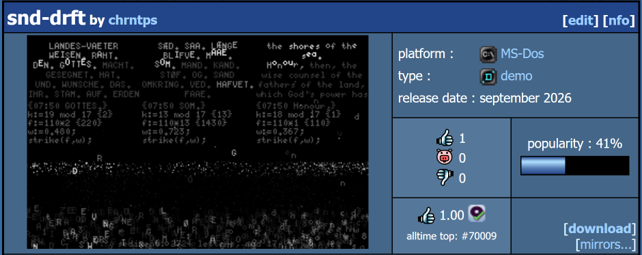
EIN. MEER. VON. SAND. was released as snd-drft by chrntps on pouet.net, which has been running since 2000 and lists tens of thousands of productions going back to the 1980s: demos, intros, music disks, ANSI packs, each with a download link, a screenshot, a platform tag and a comment thread.
Today Pouët is a loose international network of programmers, musicians and pixel artists who write real-time audiovisual programs, often for hardware that has been out of production for decades.
How to run the program on Windows machines in 2026
- Install DOSBox (www.dosbox.com, version 0.74-3 or DOSBox-X / DOSBox Staging).
- Unzip everything into one folder, for example C:\SAND.
- Double-click RUN.BAT, or start DOSBox and type:
mount c c:\sand
c:
sand
ESC quits. SAND 300 begins five minutes in.
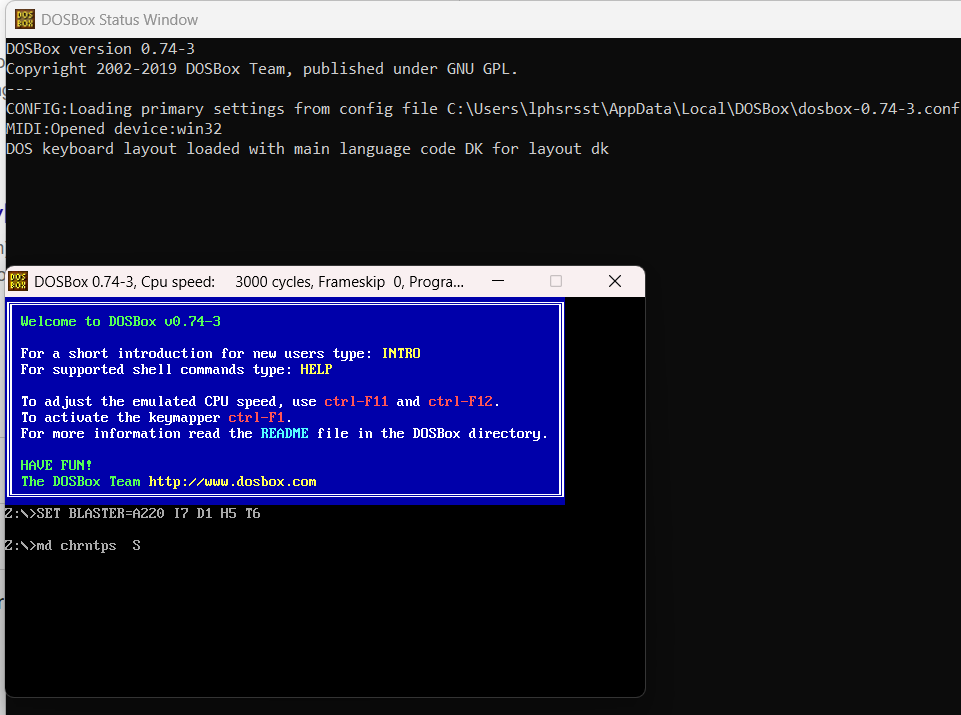
DOSBOX.CONF sets up a Sound Blaster 16 (A220 I7 D1 H5) and the fastest CPU setting. The picture follows the sound card, so the timing is exact even when the frame rate drops (about 14 frames a second when the sea is full, up to 70 when it is sparse).
The work
The letters of the sand drift monument at Tisvilde (1738), in German, Danish and English, read by one rule: each letter a partial of A2 (110 Hz), its place in the alphabet modulo M (Danish Æ, Ø, Å continue the alphabet as 27, 28, 29), the modulus drifting from 12 to 17. The soundtrack was synthesised by an APL program from the same score and is kept separate, in SAND.SND, as demos did.
Files
- SAND.EXE: the demo (16-bit real mode, large memory model, needs a 386+)
- SAND.SND: the soundtrack, raw unsigned 8-bit stereo, 22050 Hz (23.6 MB)
- DOSBOX.CONF: DOSBox settings
- RUN.BAT: starts DOSBox with those settings (Windows)
- FILE_ID.DIZ and SAND.NFO: description, instructions and credits
- SAND.ANS: the monument as ANSI art
- SRC\SAND.PAS: the program, with the rule, the sea and the columns
- SRC\SCOREDAT.PAS: the score (times, texts), as computed by the APL program
- SRC\FONT8.PAS: a 5×8 bitmap font, ISO 8859-1 (for Æ, Ø, Å)
- SRC\VGA.PAS: mode 13h, 64 greys, back buffer
- SRC\SND.PAS: Sound Blaster 16, 8-bit stereo, auto-init DMA streaming
- SRC\ENDSCR.PAS: the end screen, the monument in text mode
- SRC\TEXTS.APL, SCORE.APL, SYNTH.APL: the texts, the score and the sound, in APL
snd-drft (EIN. MEER. VON. SAND.) is a demo for MS-DOS that reads the Sand Drift Monument at Tibirke, 1738, letter by letter, as sound. Its Danish and German inscriptions and an English translation sound side by side, and every letter that has been read falls into a sea at the bottom of the screen. Released on Pouët, September 2026, by chrntps.
What is the Sand Drift Monument?
Sandflugtsmonumentet stands on a small hill in Tibirke, on the north coast of Zealand. It was raised in 1738 to celebrate the end of a long fight: from the 1500s to the 1700s, drifting sand buried farms and whole villages, until planted grass and trees held the dunes. That planting grew into Tisvilde Hegn, now a forest of 1,300 hectares. The monument speaks Danish, German and Latin. The Latin face is overgrown with moss and can no longer be read.
How does a letter become a sound?
Everything sounds over one fixed tone, A2 at 110 Hz. Each letter becomes a harmonic of that tone, chosen by its place in the alphabet, reduced modulo a number. The Danish letters Æ, Ø and Å continue the alphabet as 27, 28 and 29. Over the piece the modulus drifts from 12 to 17, so the same letter changes its tone as the rule it is read under changes.
- Vowels swell and hold; consonants strike.
- A letter that recurs often in its line sounds louder.
- Every letter said leaves a permanent trace in the drone, at the tuning it had when it was said.
- Words the languages share (sand, sea, wind, the kings’ names, 1738) ring as bells.
- The mossed-over Latin face is heard as letters without notes. Twice, everything stops.
How do I run it?
It needs a 386 or better with VGA and a Sound Blaster 16, or simply DOSBox on Windows, macOS or Linux. Unzip sand.zip into a folder such as C:\SAND, then either double-click RUN.BAT, or start DOSBox and type:
mount c c:\sand
c:
sandESC quits. sand 300 starts five minutes in. If DOSBox reports that no Sound Blaster 16 is found, type set blaster=A220 I7 D1 H5 T6 first.
What is in the download?
- SAND.EXE: the demo, 8:54.
- SAND.SND: the soundtrack, kept separate, as demos did (8-bit stereo, 22,050 Hz).
- DOSBOX.CONF and RUN.BAT: ready-made settings and a starter for Windows.
- FILE_ID.DIZ and SAND.NFO: the description, instructions and credits.
- SAND.ANS: the monument as ANSI art.
- SRC\: the full source, in Pascal (the demo) and APL (the score and the sound).
Which technologies does it use?
- APL (GNU APL): the letter rule, the score and every sound.
- Pascal, written for Turbo Pascal 7 and compiled with Free Pascal for 16-bit DOS: the demo.
- x86 assembler (NASM): an alternative version of the demo in 26 KB.
- VGA mode 13h (320×200, 64 greys), the Sound Blaster 16 with DMA streaming, and ANSI art in the DOS character set.
- Tested in DOSBox.
Are there other versions?
- Video in the making: an MP4 capture for anyone without DOSBox.
- ANSI mock-up pieces: the monument in high resolution, and the monument paired with the circuit board of a Trust 14k4 modem, similar to the one that ran NetLock once the BBS had its own phone line. The experiments started with still images based on digital macro-photography using vintage cameras and lenses; not released / published yet.
Where can I find it?
- Pouët: snd-drft by chrntps
- Demozoo: snd-drft by chrntps